Pages

.

Five Nights at Freddy’s


Well, in the wee small hours of this morning – Hallowe’en, of course – I watched the trailers for the fun-looking Five Nights at Freddy’s 2 and decided to do the famous 4/20 mode, where the AI of all the animatronics is set to maximum. I figured out a working pattern – catching Freddy right outside your door and keeping him there, then checking on Foxy every time Chica comes so you can shut the door on her and Freddy at the same time, going quickly enough not to let Bonnie in – so got my third star.

As just about everyone knows by now, FNAF is a jump-scare game. You play a security employee who is stuck in an office with limited power while four (well, strictly five) creepy animatronic puppets stalk through the corridors. If they catch you, they will forcibly cram you into a puppet suit...only the puppet suits already have animatronic parts in them, so that wouldn’t end very well for you. You can catch them by shutting doors on them, but this takes power, and you only have a limited supply so must balance being vulnerable with being able to last the night.

Now, I don’t care much for scary games, which aren’t exactly my sort of entertainment. Creepiness hasn’t got to me since I was very small and playing The 7th Guest, which should totally get a remake – that has nothing to do with that terrible 7thGuest 3 failed kickstarter a year ago today. As an adult, I mostly find creepy games either very daft or enjoyable completely separate from their supposedly creepy parts.

And it was in the latter camp that FNAF fell. I bought the game primarily to watch others play – and it succeeded nicely in that respect, with the friends who had big silly reactions to the scares still making me laugh when I think back to them. But for my part, it got no more out of me than a little jump. But that’s fine. After all, the most well-remembered part of Resident Evil hinged on just such a moment, with dogs smashing through windows.

Besides, the jump-scares aren’t what makes FNAF a scary game. That’s the pay-off, but really it’s about the tension on the higher levels, where you know several enemies are coming to get you and dealing with any one of them stands in the way of dealing with the others. The sound effects build a good atmosphere, and the game is very good at building then releasing tension – once you get past the first couple of nights where the game relies on fear of the unknown. The jump scares ultimately end up irrelevant, nothing but punishment. But for the easily-scared, there’s much more to be enjoyed than just big creepy things jumping out. In other words, the journey ends up better than the destination.

But for all I bought FNAF for the jump-scare gimmick to watch others play, I ended up really enjoying it as a challenging strategy game. It is incredibly simple, and part of the aforementioned tension comes from the fact that you can’t move, you can’t fight back, your defences are highly limited, and the best situation you can be in is doing nothing.

The real fun of it, of course, comes right at the end – the fifth, sixth and custom max-difficulty levels. That’s where you’re not sitting tensely hoping things don’t pop out. You are constantly having to balance controlling four AI programs to win a game. It’s not scary, and you will know when you lose and why, with only Foxy having any capacity for surprising you with a jump scare (and he looks a whole lot less alarming when he appears than the others). The genius of the game is that two enemies must constantly be checked on with the lights, one must be checked on with the camera as much as possible, and one must be looked at occasionally and may just sprint towards your office if you don’t get the chance to check up on him – and you only just have enough power to stop this on the 4/20 mode. I don’t care if arrogant gamers want to call the game gimmicky or boring: the last levels are, plain and simple, a fun and challenging game that I am willing to bet next to none of those who censure the game have beaten. Effectively, most of the people who dismiss it have played the tutorial and decided they beat the game on expert mode.

A few other things make the game impressive. Obviously, there’s the fact it’s a small-scale indie game that one guy made on his own. Then the way the fandom has become so large and so prolific – the super-cutesy fanart being my favourite. There’s the numerous over-the-top theories based on the sparse backstory about five murdered kids, and then there’s the excitement around the sequel.


Definitely worth the meagre price and an enjoyable challenge. And I really wanna go see the creepy animatronics at a Chuck-e-Cheese now! 
reade more... Résuméabuiyad

¡El Manzanares! - Bloody November Campaign Game 2


It was late at night on Novemeber 15th, but a light still could be seen in the building of the Junta de Defensa de Madrid. Colonel Rojo was leaning on the maps extended over the table in the operations room. Asensio's columns have made important inroads in la Casa de Campo during the day and now there was no doubt that the river Manzanares crossing at Puente de Los Franceses and Puente Nuevo was a key objective.

He put his finger on the map line representing the wall of La Casa de Campo and said to himself: "Ni un paso atrás, el tiempo del sacrificio ha llegado" (not a step back, this is the time for sacrifice). He picked up the telephone and asked for Comandante Romero...

This is the battle report of the second game in our Bloody November-Madrid 1936 campaign for Chain of Command, set in the context of the Spanish Civil War. You can find all the necessary details to play in a previous post of the blog.


Read more »
reade more... Résuméabuiyad

No Time for Picnic at Casa de Campo - Bloody November Campaign Game 1


The first dim lights of this mid-November morning showed the green and damp carpet of grass from the top of the hill where the milicianos squad took positions the night before. The early morning fog traces moving along the trees created phantomly figures of all shapes which the scared men took for the "moros", those apparently invencible men brought by the rebels from North Africa..

A strange quietness surrounded the men behind the stonewall, not even the sound of a bird that probably had left by now for the warmer southern regions of Spain... and when the men thoughts were probably turning to the past idle summer evenings spent picnicing in that same Casa de Campo, a cry from the advanced outposts was like a force landing jump into the grim realities of a battle about to start ... "¡Cuidado, ahí vienen!"


This is the battle report of the first game in our Bloody November-Madrid 1936 campaign for Chain of Command, set in the context of the Spanish Civil War. You can find all the necessary details to play in a previous post of the blog.

Republican Patrol markers and Communist Dice

Read more »
reade more... Résuméabuiyad

Villers Bocage Campaign - Game 2


Today we played the second scenario of the Villers Bocage campaign for Chain of Command after a very long spell (first game played in August). All details of the campaign and background can be found in the previous pots.

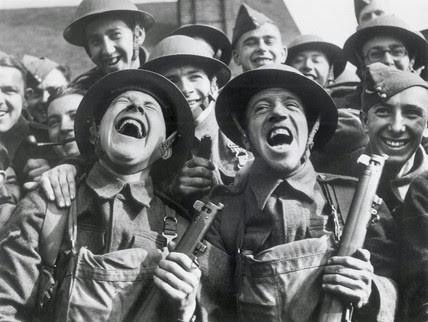
If you wonder the reason for using the photo above to illustrate the post, just read through to the end...

I played the Germans and after taking into consideration the casualties of the previous engagement (7 casualties and the squad NCO), I ended up with two full squads and a small 4-men team with an LMG. My force moral was adjusted by -1 after rolling all the effects of losing the battle (all information available in At the Sharp End, the campaign supplement for Chain of Command).


Read more »
reade more... Résuméabuiyad

¡Viva la República! - Heavy Weapons reinforcements


I spent Saturday morning finishing some  heavy weapons additions to reinforce my Repuiblican forces. Very handy considering the hard times coming defending Madrd form the fascist agression in our Spanish Civil War campaign.

I painted a Maxim HMG with a crew of 3...


... A Hotchkiss MMG with 2 crew...


... and a heavy 81mm mortar.


The latter are unlikely to see a lot use on the table (heavy mortars are considered off-board assets in Chain of Command) ... but who could resist buying such a beauty!!

All models are from the Empress Miniatures SCW series

reade more... Résuméabuiyad

Bloody November - Madrid 1936: Reading and Information Sources


Following the publication yesterday of the introductory post to our Spanish Civil War campaign for Chain of Command, I have received several communications requesting recommendations on information sources for the Battle of Madrid in 1936.

I may have to disappoint my English-speaking readers, but unfortunately I haven't been ablo to find any good reliable source in the language of Shakespeare, so what follows are references to bibliography in Spain.

Another warning: I’m not intending neither to be exhaustive in my suggestions, nor pretending that I’ve read every single book published on the topic. I consider myself a serious history aficionado (in fact for me is the other side to enjoy wargaming as a hobby) but I try to balance deep studying a period and using that information for my game.

In no particular order of preference, but these are most of the books/publications that I did useto get to know the period and on which I have some opinion:

1# Desperta Ferro Contemporánea 4: Madrid 1936
This is the 4thissue published by Desperta Ferro in its new series of magazines focused on modern (XX and XXI century) conflicts. I really like this magazine and its approach to combine popular military history with wargaming, providing an excellent background when undertaken a new period or a specific event within a period of your interest.

Read more »
reade more... Résuméabuiyad

Bloody November: A Chain of of Command España Campaign in Madrid 1936


Introduction
After the failed previous July coup, Franco’s colonial troops in North Africa had reached the outskirts of Spain’s capital city by early November 1936, in an unstoppable drive, overcoming without contempt all armed opposition found on their way up from Sevilla.

The Republican Government has shamelessly left to Valencia with the enemy at the gates, escaping at night and without notice. But just before leaving, it appointed the dull and grey General Miaja commander of the garrison defending the city.

However the orders left to him in a closed envelope at the War Ministry office, opened during the early hours of November 6th, made it clear that the Government lacked any hope of the city surviving the Nationalist steamroller, suggesting instead to put a token resistance at best and then to pull back with the garrison remnants towards a new defensive line on the road leading to Valencia.
Original Italian CTV 1937 Map of Madrid Area

But miracles exist, and against all odds the city resisted the attacks of the rebel columns. The milicianos surprisingly (and unexpectedly) put up a fierce fight in the southern suburbs of Madrid.
In the left flank, a Nationalist column was expected to take La Casa de Campo, a popular natural park west of Madrid and across the Manzanares, used by the madrileños to shelter from the hot summer afternoons and to picnic on the bank of its famous artificial lagoon during weekends.
The attack was launched in the early hours of November 8th but quickly petered out, although not before conquering a dominant hill within the park called Cerro Garabitas. This elevation will allow the Nationalists observers to direct the guns and to merciless pound the central area of Madrid over the next years.
However, the failure to enter Madrid in this first push also represented for the Republicans a much needed infusion of moral and the cry of ¡No pasarán! now reverberated across the city and Miaja unexpectedly became the people’s hero and the symbol of the resistance like Petain in Verdun during the Great War.
Defending La República, Winter 1936
The following days saw renewed Nationalists efforts and much hand-to-hand fighting among the trees of Casa de Campo woods until on November 13th they finally reached the river Manzanares.
They now were in control of a 500 meters strip along the river's west bank, extending from El Puente (bridge) de los Franceses and Puente Nuevo on the right, to the crossing overlooking La Ciudad Universitaria (the University District) on the extreme left.
On the 15th General Varela ordered Asensio to take these bridges and to move into Madrid, allocating a squad of Pz Is, also called negrillos due to its dark grey panzer colour, to provide more weight to the attack.
Read more »
reade more... Résuméabuiyad